
Repair and Rehabilitation
Post-Tensioning in Concrete Restoration
Post-tensioning is a process of applying active reinforcement to an existing concrete structure by introducing compressive stresses to counteract tensile stresses (which cause cracking or failure). In restoration, external or internal PT systems are added to improve structural performance.
Common Applications
1. Bridge strengthening
2. Parking garage restoration
3. Building retrofits (e.g., seismic upgrades)
4. Slab or beam strengthening due to increased load requirements
5. Repair of deflected or cracked concrete members
Techniques for Restoration Using Post-Tensioning
External Post-Tensioning
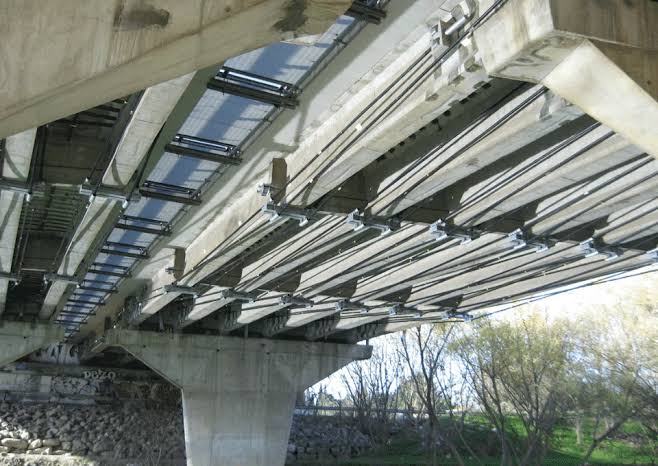
Tendons are installed outside the concrete section, anchored at both ends.
Effective when internal access is limited or concrete is severely damaged.
Used in bridge girders, beams, and slabs.
Internal Post-Tensioning (Retrofitted)
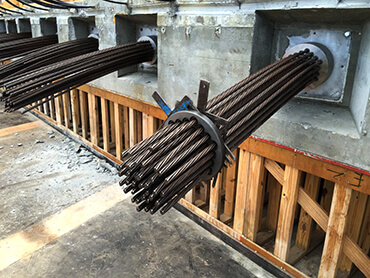
Tendons are embedded in cut grooves or ducts created in the concrete.
Grouted after stressing (bonded PT), or left greased and sheathed (unbonded PT).
Segmental Jacketing with Post-Tensioning
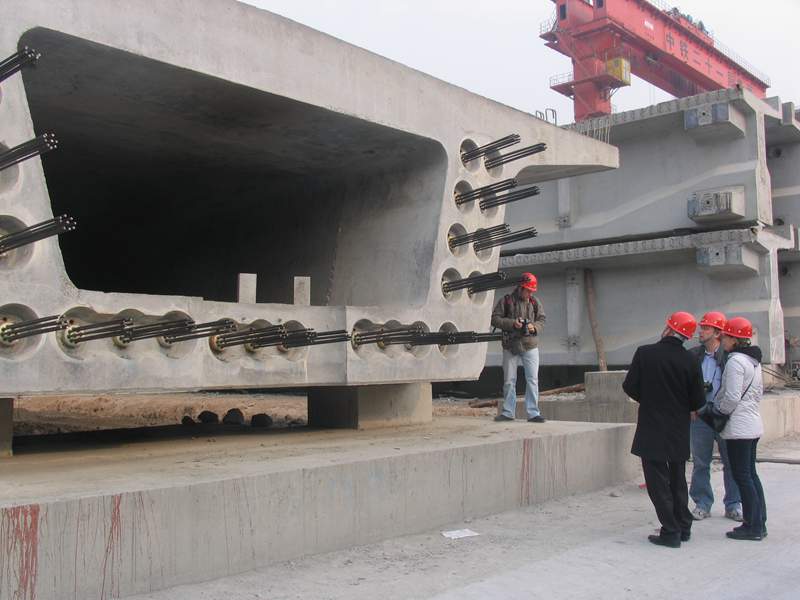
Damaged columns or piers are wrapped (jacketed) with new concrete or fiber-reinforced polymers (FRP), and post-tensioned hoops or vertical bars are added.
Structural Strengthening Using Post-Tensioning
Structural strengthening with post-tensioning involves applying compressive forces to a structural element (slab, beam, column, girder, etc.) using high-strength steel tendons. This active reinforcement counteracts tensile forces, controls deflections, closes cracks, and improves the performance and lifespan of the structure.
Common Applications
| Application | Description |
|---|---|
| Bridge girders | Increase capacity or correct sagging |
| Slabs and beams | Carry higher loads or fix deflections |
| Parking structures | Strengthen slabs or ramps |
| High-rise buildings | Seismic strengthening or load redistribution |
| Industrial floors | Control cracking due to heavy equipment or point loads |
| Retaining walls and tanks | Control cracking and improve performance under pressure |
Types of Post-Tensioning for Strengthening
1. External Post-Tensioning
Tendons are placed outside the concrete cross-section
Connected to the structure via anchorages and deviators
Tensioned after installation
Can be monitored, replaced, or adjusted later
Typical Use: Bridge strengthening, beam retrofitting
2. Internal Post-Tensioning (Retrofitted)
Grooves or ducts are cut into existing concrete
Tendons are embedded and grouted
Often used when appearance or space is a concern
3. Prestressed Jacketing
Used for columns and piers
Jackets (concrete or FRP) are applied with hoop or vertical tendons for confinement
Improves seismic capacity and ductility
STRUCTURAL INTEGRITY USING POST-TENSIONING
Post-tensioning (PT) enhances the structural integrity of concrete elements by introducing compressive forces that counteract tensile stresses. This approach significantly improves the strength, serviceability, and durability of both new and existing structures.
What Is Structural Integrity in Post-Tensioned Systems?
Structural integrity refers to the ability of a structure to:
Carry intended loads without failure
Resist cracking, deflection, or collapse
Maintain performance over time under various conditions
Post-tensioning contributes to this by actively reinforcing the structure, which improves internal stress distribution and reduces the likelihood of failure modes such as cracking, excessive deflection, or fatigue.
HOW POST-TENSIONING IMPROVES STRUCTURAL INTEGRITY
1. Crack Control
PT introduces pre-compression in concrete, which counteracts tension from live loads.
Prevents or significantly reduces tensile cracking.
This enhances durability and protects reinforcement from corrosion.
2. Increased Load Capacity
PT enables structural elements to carry higher loads than conventional reinforced concrete.
Beneficial in high-rise buildings, bridges, and parking decks.
3. Improved Deflection Control
PT reduces long-term deflection and creep by keeping the concrete in compression.
Especially important for long-span slabs or cantilevers.
4. Enhanced Ductility and Energy Absorption
Especially in seismic zones, post-tensioned elements can absorb and dissipate energy.
Reduces the risk of catastrophic collapse during an earthquake.
5. Minimized Structural Mass
With PT, thinner and lighter sections can be designed.
Reduces overall structural weight and associated seismic demands.